

Spanish for preschoolers
Spanish for preschoolers: first words, phrases and games
Start with words your child can use today: hola, gracias, más, agua, then colors, numbers to ten and the animals they love. Say them at the same moments every day, and play with them a few minutes at a time. Here are 112 first words with how to say each one, ten everyday phrases, and games that make them stick.
 Tap to hear
 Printable
Updated November 2026 · For ages 2–6 · By the Cleoland team

First words
First Spanish words for preschoolers, by theme
Eight small lists, in the Latin American Spanish most often heard in the US. Each word has its el or la where that helps, a say-it-like guide with the loud part in capitals, and its meaning. Tap a word to hear it.
Tap any word to hear it in your device’s Spanish voice.
 Greetings and polite words
16 words
 Family
14 words
El goes with boys and men, la with girls and women.
 Colors
11 words
Colors come after the thing, and a color ending in o changes to a with a “la” word: la pelota roja is “the red ball.”
 Numbers 1 to 10
10 words
 Animals
16 words
 Food and drink
15 words
 Body
15 words
Los and las mean there is more than one.
 Home
15 words
Say it like this
How to say Spanish words, in ten small rules
Spanish is spelled the way it sounds, so a few rules cover almost every word on this page.
- a, e, i, o, uAlways ah, eh, ee, oh, oo. Each vowel has one sound, in every word.
- hSilent. Hola is OH-lah.
- jLike an English h. Rojo is RROH-hoh.
- llLike an English y. Amarillo is ah-mah-REE-yoh.
- ñLike the ny in canyon. Baño is BAH-nyoh.
- vA soft b. Vaca is BAH-kah.
- z, and c before e or iLike an s. Azul is ah-SOOL, cinco is SEEN-koh.
- rr, and r at the start of a wordA rolled r: perro, rojo, rana. A long “rrr” is close enough.
- á, é, í, ó, úThe mark shows which part to say louder: mamá is mah-MAH.
- ¿ ? and ¡ !Questions and exclamations get a mark at both ends: ¿Cómo estás?
El and la: every Spanish thing is an “el” word or a “la” word, and los and las are for more than one. Words ending in o are usually el and words ending in a are usually la, so teach the two together, like one long word: el perro, la casa. Two to watch: el agua and la mano.
Everyday Spanish
Ten Spanish phrases for daily routines
A phrase said at the same moment every day is learned without a lesson. Pick two this week and add one more each week.
Tap any word to hear it in your device’s Spanish voice.
 Phrases for the daily routine
10 phrases
Play
Spanish games for preschoolers that make the words stick
No printing and no prep. Each game uses the word lists above and takes about five minutes.
Busca un color
Colors
Say “Busca algo rojo” (BOOS-kah AHL-goh RROH-hoh: find something red). Your child runs to touch something red and says “rojo.” Then call a new color.
Make it harder: they call the color and you run.
Ages 2–6
Simón dice
Body words
Simon Says in Spanish: “Simón dice: tócate la nariz” (TOH-kah-teh lah nah-REES: touch your nose). Swap in la cabeza, los pies and la panza.
Make it harder: leave out “Simón dice” now and then, as in the English game.
Ages 3–6
Count everything
Numbers
Count stairs, grapes and pushes on the swing: uno, dos, tres. Stop at tres with a 2-year-old and work up to diez.
Make it harder: count down from cinco for a rocket launch.
Ages 2–6
La tiendita
Food and polite words
Play shop with toy food. You ask “¿Qué quieres?” (keh kee-EH-rehs: what would you like?). They answer “Una manzana, por favor,” and say “gracias” when you hand it over.
Make it harder: swap places, so they ask the question.
Ages 3–6
Animal voices
Animals
Animals sound different in Spanish: el perro says guau, el gato says miau, la vaca says mu, el pollito says pío and el pato says cuac. Make a sound; your child names the animal.
Make it harder: they make the sound and you name it.
Ages 2–5
¿Dónde está?
Questions
Hide a teddy and ask “¿Dónde está el oso?” When they find it, say where it was: “¡En la cama!” (on the bed).
Make it harder: they hide it and ask you.
Ages 2–5
Sticky-note house
Home words
Write la puerta, la mesa, la silla and la ventana on sticky notes. Your child sticks each one where it belongs, and you both say the word when you pass it.
Make it harder: mix the notes up and let them fix the house.
Ages 4–6

Veo, veo
Colors and things
The Spanish I Spy. Say “Veo algo azul” (BEH-oh AHL-goh ah-SOOL: I see something blue). Your child points at blue things until they find yours.
Make it harder: give two clues: “Veo algo azul en la cocina.”
Ages 3–6
Pairs
Any word list
Draw six things on cards, twice each, and play pairs. A pair only counts when you both say its Spanish word.
Make it harder: match a picture card to a card with the written word.
Ages 3–6

The Spanish-only toy
Speaking
Pick one stuffed animal that only understands Spanish. To greet it, feed it or tuck it into a box, your child has to use Spanish words.
Make it harder: the toy “asks” ¿Cómo estás? every morning.
Ages 3–6

Freeze dance
Listening
Dance to a Spanish children’s song. Pause it and call a body word, “¡Manos!” Everyone freezes with that part in the air.
Make it harder: call two: “¡Manos y pies!”
Ages 2–6
Word of the day
Remembering
Choose one word at breakfast and see how many times you can both use it before dinner. Keep a tally on the fridge.
Make it harder: on Friday, try to remember all five words from the week.
Ages 3–6
Sing
Traditional Spanish songs for kids
Songs carry rhythm, rhyme and whole phrases. The Texas State Library lists these four among traditional children’s songs in Spanish. Look them up by name at your library or wherever you listen to music.
Los pollitos
A song about baby chicks who call out when they are hungry and cold, and the mother hen who looks after them. Listen for hambre (hungry) and frío (cold).
Los elefantes
A counting song: one more elephant joins in every verse, for as long as you want to keep singing.

De colores
A song about the colors of the fields in spring. The Texas State Library notes that it came to the Americas from central Spain in the sixteenth century.

Arroz con leche
A song that is also a circle game: children hold hands and walk around one child in the middle.
For parents
Teaching Spanish when you don’t speak it yourself
You can give your child a real start with a small set of words and a daily habit. Here is how to do it without pretending to be fluent.
- 1
Learn five words a week, together
You don’t need to be ahead of your child. Pick five words on Sunday, put them on the fridge, and use them all week. In a year that is more than 250 words.
- 2
Borrow a real Spanish voice
Tap the words on this page, play Spanish children’s songs, borrow bilingual picture books from the library, and ask any Spanish-speaking relatives, neighbors or teachers to say hello in Spanish.
- 3
Tie each word to a routine
“Agua” every time you fill the cup. “Zapatos” at the door. Words stick when they come with the same moment every day.
- 4
Keep everyday talk in your strongest language
The American Academy of Pediatrics and the American Speech-Language-Hearing Association advise parents to use the language or languages they are most comfortable with when talking with their child. Spanish can be a game you add to the day, not a rule for the whole day.
- 5
Trust the spelling
Spanish is spelled the way it sounds, and each vowel has one sound. Once you know the handful of sounds below the word lists, you can read a Spanish picture book out loud.
- 6
Praise the try, then say it right
If they say “gato” for the dog, answer “¡Sí, un animal! El perro.” They hear the right word without being told they were wrong.
- 7
Repeat before you add
Keep the same few words going for a week before adding more. Young children like the hundredth time as much as the first.
- 8
Find other speakers
Library story times, playgroups and dual-language programs give your child other people to use the words with.
What to expect
How much Spanish to expect at 2–3 and at 4–6
A few minutes of Spanish a day builds words, an ear for the sounds and a liking for the language. It does not make a child bilingual by itself: that takes frequent exposure and regular practice, with people who speak it.
Ages 2–3
Listening first, then single words
- Understands a word before saying it: points to la pelota when you ask where it is.
- Says a few single words that are useful to them: hola, adiós, más, agua, no.
- Joins in the actions of a song before the words.
- Mixes Spanish and English in one sentence. The AAP and ASHA describe this as normal, and not a sign of confusion.
Ages 4–6
Lists, songs and short phrases
- Counts to diez and names colors, animals and family.
- Answers a few set questions: “¿Cómo te llamas?” “Me llamo…”
- Uses short phrases that get results: “Más agua, por favor.”
- Sings a whole song from memory, and starts to notice el and la.
These are our own rough guides for a child hearing a little Spanish most days, not milestones. This page is information, not advice: if you have concerns about your child’s speech or language in any language, talk with your child’s doctor or a speech-language pathologist.
Spanish with Cleo
Spanish in Cleoland
Cleoland has 20 games, and one of them is for Spanish words. It plays at the age you set in the app.
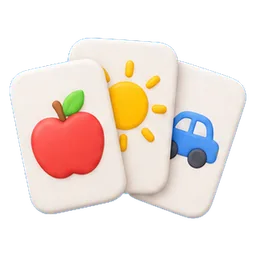
Spanish Pairs
Match each thing to its Spanish word, and Cleo says it in a Spanish voice. (In Cleo’s other languages it teaches English.)
- Ages 2–33 pairs: a picture and its word
- Ages 4–54 pairs
- Ages 6–75 pairs, word to word
- Ages 8+6 pairs, with “the” and plurals
Cleo also speaks 9 languages: English, Spanish, French, German, Italian, Portuguese, Russian, Japanese and Korean. Your child can switch with the button next to the mic, and she talks and makes things in that language.

Try it with Cleo
Match the word, hear it in Spanish
In Spanish Pairs, your child matches each thing to its Spanish word, and Cleo says it in a Spanish voice. At 2–3 it is three pairs of a picture and its word; at 8 and up it is six pairs, with “the” and plurals.

Questions about Spanish for preschoolers
How do I teach my preschooler Spanish at home?+
Start with a few words your child can use right away, such as hola, gracias, más and agua, and say them at the same moments every day. Add colors, numbers and animals through games and songs, a few minutes at a time. Short and daily works better than one long lesson a week.
What Spanish words should a preschooler learn first?+
Greetings and polite words (hola, adiós, por favor, gracias), family (mamá, papá), colors, numbers one to ten, animals, food, body parts and things around the house. Learn each thing with its el or la, as one piece: “el perro,” not just “perro.”
Can I teach my child Spanish if I don’t speak it?+
You can start them off. Learn a handful of words together each week, use recordings, songs and bilingual books for the real sound, and keep your everyday talk in the language you know best. To become fluent, a child needs lots of time hearing and using Spanish with people who speak it.
Will learning Spanish confuse my child or delay their English?+
No. A family guide written with the American Speech-Language-Hearing Association says that using multiple languages does not confuse children or cause speech or language delays. The American Academy of Pediatrics adds that mixing two languages in one sentence does not mean a child is confused.
What is the best age to start learning Spanish?+
Any age works. The American Academy of Pediatrics says young children appear to learn languages easily and quickly, and that people can learn another language at any age with frequent exposure and regular practice.
How do you say the colors in Spanish?+
Rojo (red), azul (blue), amarillo (yellow), verde (green), anaranjado (orange), morado (purple), rosa (pink), café (brown), blanco (white), negro (black) and gris (gray).
How do you count to ten in Spanish?+
Uno, dos, tres, cuatro, cinco, seis, siete, ocho, nueve, diez.
Sources
- American Academy of Pediatrics (HealthyChildren.org), with ASHA: Young Children Learning Multiple Languages: Parent FAQs (updated November 20, 2025)
- Communication Health Support Association, with the American Speech-Language-Hearing Association: Learning More Than One Language
- Texas State Library and Archives Commission: Traditional Songs, Rhymes, Fingerplays, and Games in Spanish and English
- Word lists, say-it-like guides and games were written by the Cleoland team.
Keep reading

 Ages 3–8
Talk
Questions to ask kindergarteners: fun, funny and would you rather
178 questions that get young children talking, sorted by kind, with tips for keeping the conversation going.
 Ages 3–4
Games
Games for preschoolers: learning games for ages 3 and 4
Simple games for colors, counting, letters and listening that need nothing but you, plus the games Cleo plays at 2–3.
 Ages 3–7
Songs
Good morning songs for kindergarten, and goodbye songs
Short songs to start and end the day, set to tunes every child knows. Add your child’s name and sing along.
 Ages 2–8+
Games
I Spy: how to play, and ways to make it a learning game
The rules of I Spy, versions for ages 2 to 8, learning versions for colors, sounds and numbers, and 72 ready-made clues by place.
 Ages 3–5
Learning
Preschool at home: a simple, playful daily rhythm
What to cover in preschool at home, a daily rhythm that works, and activities that need almost no prep.
 Ages 4
Ages
Games for 4-year-olds: what they’re learning and what to play
What most 4-year-olds can do (from the CDC), the games that fit this age, and what to look for in an app.